
Home / Films
July 20, 1969: The night America stayed up
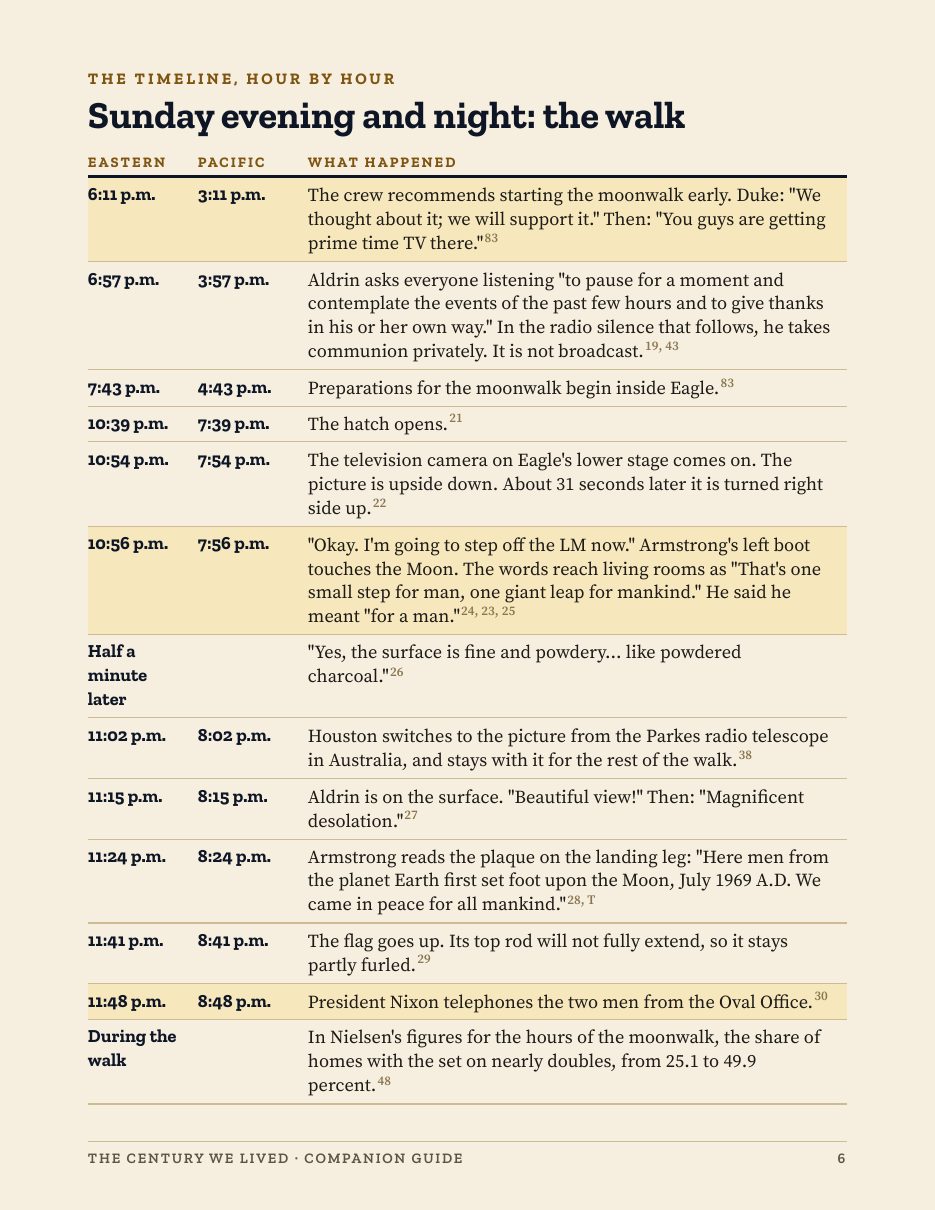
At 10:56 p.m. Eastern on Sunday, July 20, 1969, Neil Armstrong stepped onto the Moon, and America watched on a blurry picture relayed through Australia.
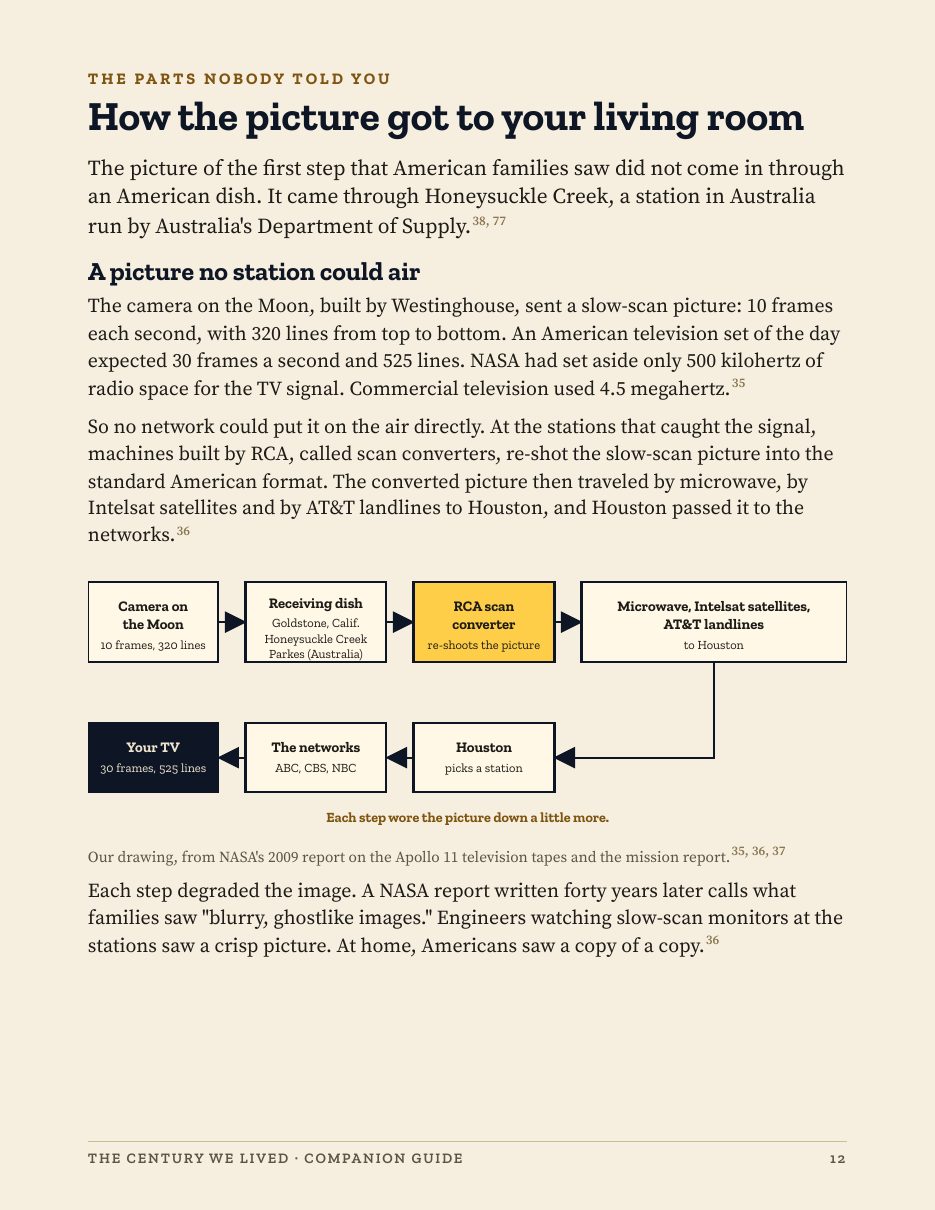
This is that night as families lived it, and the parts most people never heard: a computer alarm during the landing, a moonwalk moved up from 2 a.m., and how the picture actually reached the living room.

Companion guide, printable PDF
The Night America Stayed Up: the companion guide
A 40-page guide in large, easy-to-read type, made to print at home on ordinary letter paper. It follows the whole week hour by hour, from launch to splashdown, with every time given in both Eastern and Pacific time. Every fact carries a numbered source, and all the photographs are public-domain NASA and government images.
$9 instant download
Checkout coming soon
Payment is by Stripe. When the link is connected, you pay here and come straight back to the download.
What's inside
- An hour-by-hour home-front timeline in Eastern and Pacific time, from launch day to splashdown and the Monday papers
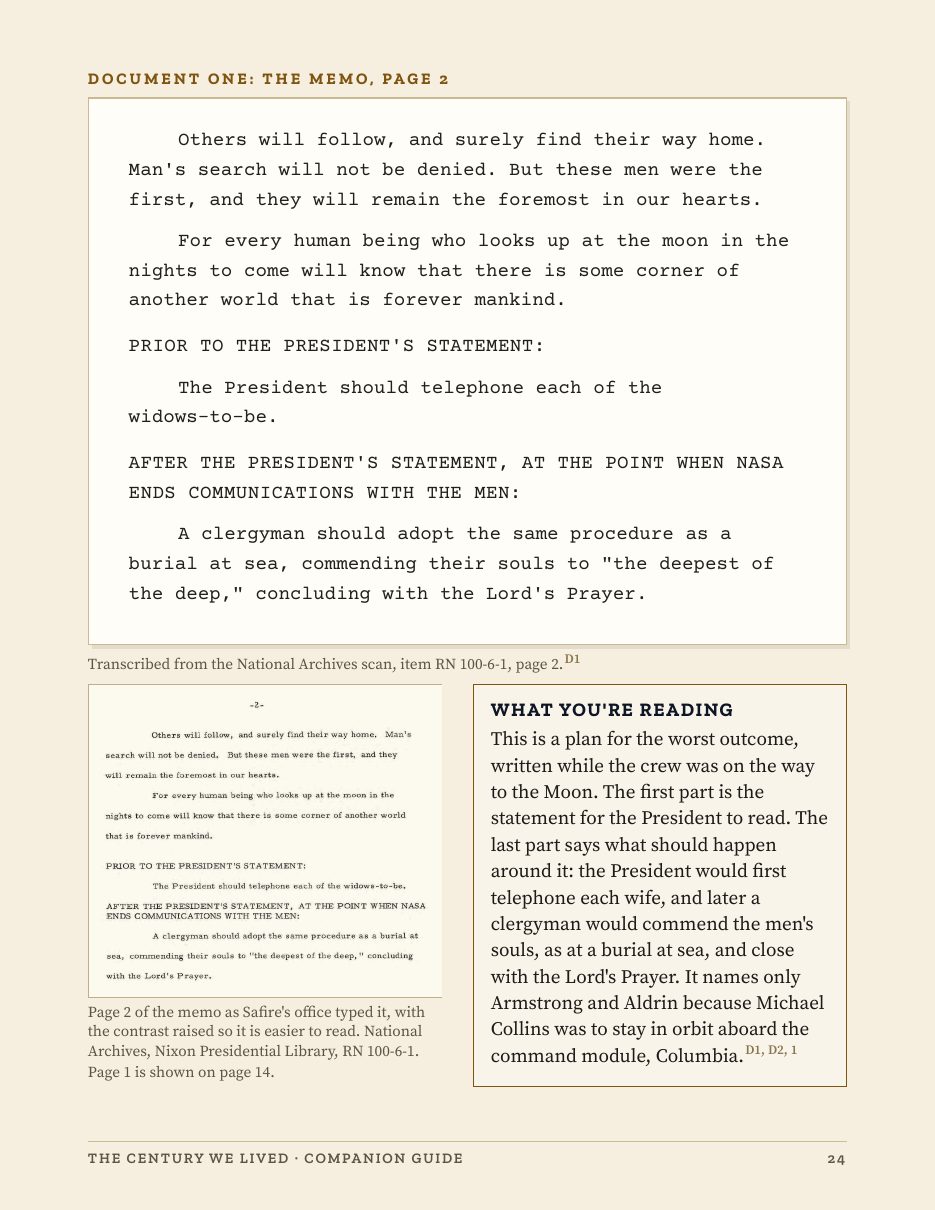
- "The parts nobody told you": the 1202 alarm, the fuel calls, the early moonwalk, how the TV picture reached you, the speech written in case of disaster, and the national day off
- Twelve Moon-landing myths, each set beside what the documents actually say
- "In their own words: the documents" (9 pages): the full text of William Safire's "In Event of Moon Disaster" memo of July 18, 1969, including its instructions for the President's calls to the widows and the burial-at-sea prayer (never delivered); the full text of Proclamation 3919, the National Day of Participation; and NASA's 1969 transcript of President Nixon's telephone call to Armstrong and Aldrin, with mission clock and Eastern and Pacific times. Each comes with a note on who wrote it and why, a plain-words "What you're reading" note, transcription notes, facsimile pages of the memo and the NASA transcript, and a small box on the plaque left on the Moon
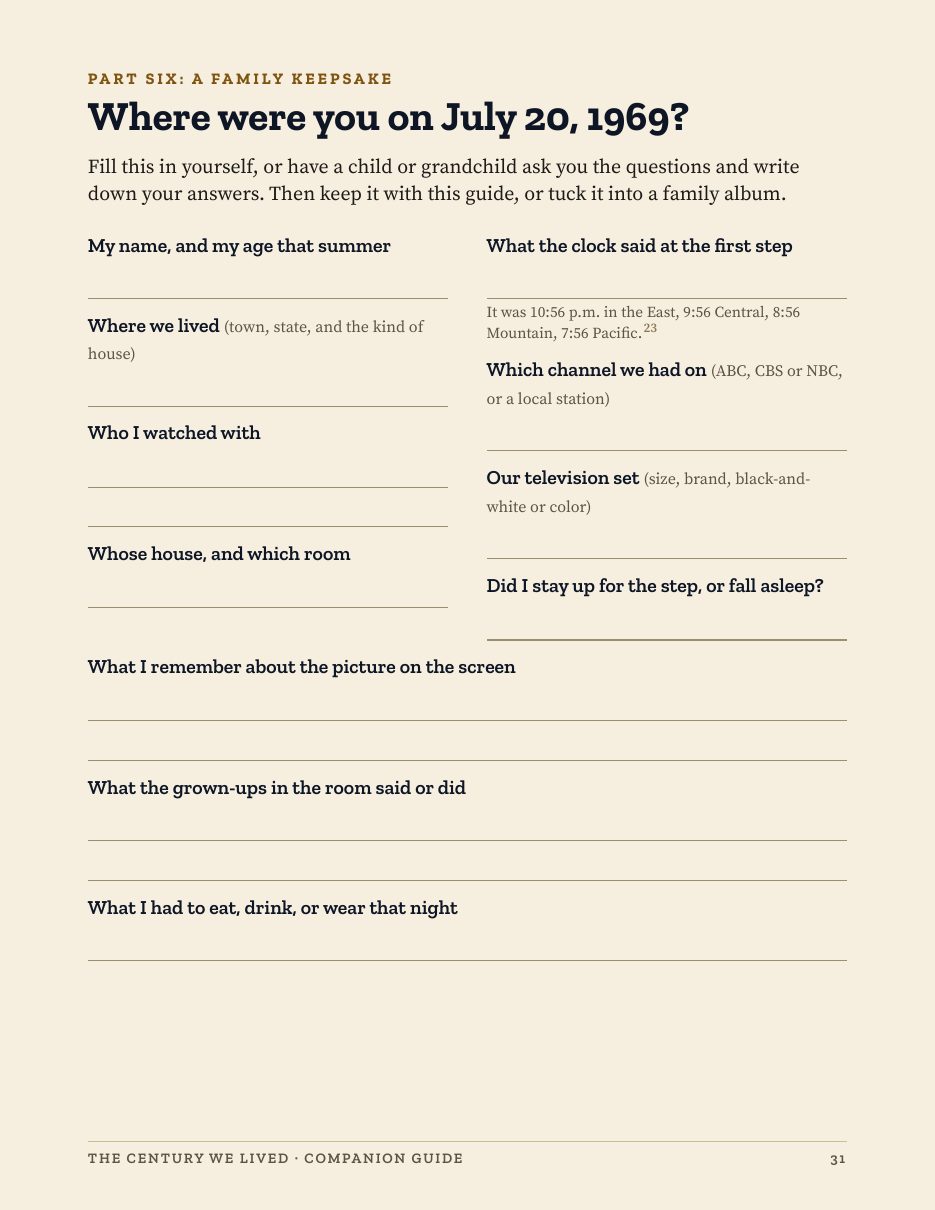
- "Where were you?" keepsake pages to fill in with your children or grandchildren
- What to read, listen to and watch next, plus 101 numbered sources and full picture credits
Look inside
Running time about 33 minutes. Narrated by Michael Strange. Watch on YouTube
Chapters
- 0:00 Cold open: Ten fifty-six on a Sunday night
- 1:24 A Wednesday morning in Florida
- 6:05 Sunday afternoon: 1202
- 10:44 The evening they moved it up
- 15:15 The picture from the Moon
- 20:56 Everyone in the room
- 26:52 Monday's papers, and coming home
- 31:46 Too soft
Further reading and listening
- A Man on the Moon, Andrew Chaikin (1994), audiobook: Find it on Amazon (paid link)
- First Man: The Life of Neil A. Armstrong, James R. Hansen (2005), audiobook: Find it on Amazon (paid link)
- Carrying the Fire, Michael Collins (1974), audiobook: Find it on Amazon (paid link)
- Return to Earth, Buzz Aldrin with Wayne Warga (1973), print: Find it on Amazon (paid link)
As an Amazon Associate I earn from qualifying purchases.
Sources
- Apollo 11 Mission Report, NASA MSC-00171 (1969): https://apollojournals.org/alsj/a11/A11_MissionReport.pdf
- Apollo 11 air-to-ground transcript and Apollo Lunar Surface Journal: https://apollojournals.org/alsj/a11/
- Apollo Flight Journal (launch commentary): https://apollojournals.org/afj/
- The Apollo 11 Telemetry Data Recordings: A Final Report (NASA, 2009), on the TV signal, scan converters and stations
- Broadcasting magazine, July 28 and Sept. 1, 1969 (Nielsen figures): https://www.worldradiohistory.com/
- Proclamation 3919, 34 FR 12079 (July 18, 1969): https://www.govinfo.gov/content/pkg/FR-1969-07-18/pdf/FR-1969-07-18.pdf
- Safire memo, July 18, 1969 (NARA): https://www.archives.gov/files/presidential-libraries/events/centennials/nixon/images/exhibit/rn100-6-1.pdf
- Nixon Library White House Photo Office selections, Apollo 11: https://www.nixonlibrary.gov/sites/default/files/2020-01/Nixon_Library_WHPO_selections_Apollo_11.pdf
- Sarkissian, "On Eagle's Wings," Publications of the Astronomical Society of Australia (2001), on Parkes
- The New York Times, Washington Post and Wapakoneta Daily News, July 21, 1969; New York Amsterdam News, July 26, 1969; The New Yorker, July 26, 1969
Credits
- Footage and photos: NASA (Johnson Space Center, Kennedy Space Center, Marshall Space Flight Center); public domain.
- Moonwalk TV: NASA Manned Spacecraft Center 16mm kinescopes, National Archives (NARA) 255-FR-7728 and 255-FR-7729.
- Apollo 11 16mm onboard film: NASA, via the Internet Archive (Apollo1116mmOnboardFilm).
- Nixon and Borman watching the launch: Richard Nixon Presidential Library and Museum / NARA (WHPO-1558).
- Nixon on the phone to the Moon: Richard Nixon Presidential Library and Museum / NARA (photo: Oliver F. Atkins), WHPO-1577-12, NARA ID 66394155.
- Thumbnail photo (crowd at the Kennedy Space Center press site watching the Apollo 11 launch): NASA Marshall Space Flight Center, image 6900589; public domain.
- Documents: Safire memo "In Event of Moon Disaster" (NARA); Proclamation 3919, Federal Register 34 FR 12079.
- Maps: our own, drawn from US Census Bureau boundary files and Natural Earth (public domain). Graphics: our own.
- Music (YouTube Audio Library License; no attribution required, credited anyway): "Nostalgic Place" by Myuu; "Glacial Melting Point" by Asher Fulero; "Searching For Time" by Telecasted; "Elegy" by Wayne Jones.
- Newspaper headlines are re-set in our own type, quoted for reporting; no page images are shown.
A note on AI
3 short scenes (about 6 seconds each) are AI illustrations of generic home settings: an empty living room, a family seen from behind, a street at night. Each is labeled "Illustration (AI)" on screen. They do not depict real people or real events. Everything else is archival material or our own maps and graphics.